

Llama 2 is designed to provide flexible and scalable AI language models for developers and researchers working on modern artificial intelligence projects.
The models can perform tasks such as:
- Text generation
- Conversational AI
- Coding assistance
- Summarization
- Question answering
- Content analysis
- AI automation workflows
Llama 2 is commonly used in:
- AI research environments
- Chatbot systems
- Productivity applications
- Educational AI projects
- Business automation solutions
- Developer experimentation workflows
Depending on the model version and deployment method, users may gain access to:
- Lightweight and large-scale model variants
- Local AI inference support
- Fine-tuning workflows
- Cloud AI deployment integration
- Multi-language processing capabilities
- API and framework compatibility
- AI customization features
One major advantage of open AI models like Llama 2 is deployment flexibility because developers can run models locally, customize behavior, and build independent AI systems without relying entirely on closed cloud platforms.
The platform is especially useful for:
- AI developers
- Researchers
- Machine learning engineers
- Data scientists
- Students
- Open-source AI communities
who want greater control over AI experimentation and deployment workflows.
Llama 2 also helped increase accessibility to advanced language model technology within the open AI ecosystem.
📌 What is Llama 2?
Llama 2 is an open large language model (LLM) family developed by Meta for artificial intelligence research, chatbot development, natural language processing, coding assistance, and machine learning applications.
The model family is designed to help developers, researchers, businesses, and AI enthusiasts build AI-powered applications, automate workflows, generate content, and perform advanced language understanding tasks.
Llama 2 became popular because it provides powerful AI capabilities with flexible deployment options for both research and commercial use cases.
🚀 Key Uses
- AI chatbot development
- Natural language processing workflows
- AI content generation
- Coding and programming assistance
- Research and machine learning experiments
- Building AI-powered applications
- Local AI deployment workflows
- Educational AI projects
- Text summarization and analysis
- Automation and productivity solutions
💻 System Requirements (General)
Minimum Requirements
- Windows / Linux / macOS
- 8GB RAM minimum
- Multi-core processor
- Python development environment
- Stable internet connection for setup and downloads
Recommended Requirements
- 16GB–32GB+ RAM
- NVIDIA GPU with CUDA support
- SSD storage
- Linux-based AI development environment
- Modern AI frameworks such as PyTorch
- High-performance GPU for larger model versions
🔄 Alternatives
- Google Gemma
- Mistral AI
- GPT models
- Claude AI
- Falcon LLM
- DeepSeek AI
- Phi models
❓ FAQ
Q1. What is Llama 2 used for?
It is used for AI development, natural language processing, chatbot creation, coding assistance, and machine learning workflows.
Q2. Is Llama 2 open source?
Llama 2 is distributed as an open-weight AI model family with licensing terms for research and commercial usage.
Q3. Can it run locally?
Yes, many versions can run locally depending on available hardware resources.
Q4. Is it useful for developers?
Yes, developers widely use it for AI applications, research, and experimentation.
Q5. Does it require a GPU?
Basic inference may run on CPUs, but GPUs significantly improve performance and efficiency.
Features
✔ Large language model functionality
✔ Natural language processing support
✔ AI chatbot development compatibility
✔ Coding and programming assistance
✔ Text generation and summarization
✔ Local AI deployment support
✔ Fine-tuning and customization workflows
✔ Multi-language AI processing capabilities
✔ Research and experimentation support
✔ Open-weight AI model accessibility
✔ Cloud and local integration flexibility
✔ Educational AI project compatibility
✔ Developer-friendly AI framework support
✔ Scalable AI model architecture options
👍 Pros & 👎 Cons
Pros
- Flexible local AI deployment options
- Useful for developers and researchers
- Supports AI experimentation and customization
- Strong open AI ecosystem support
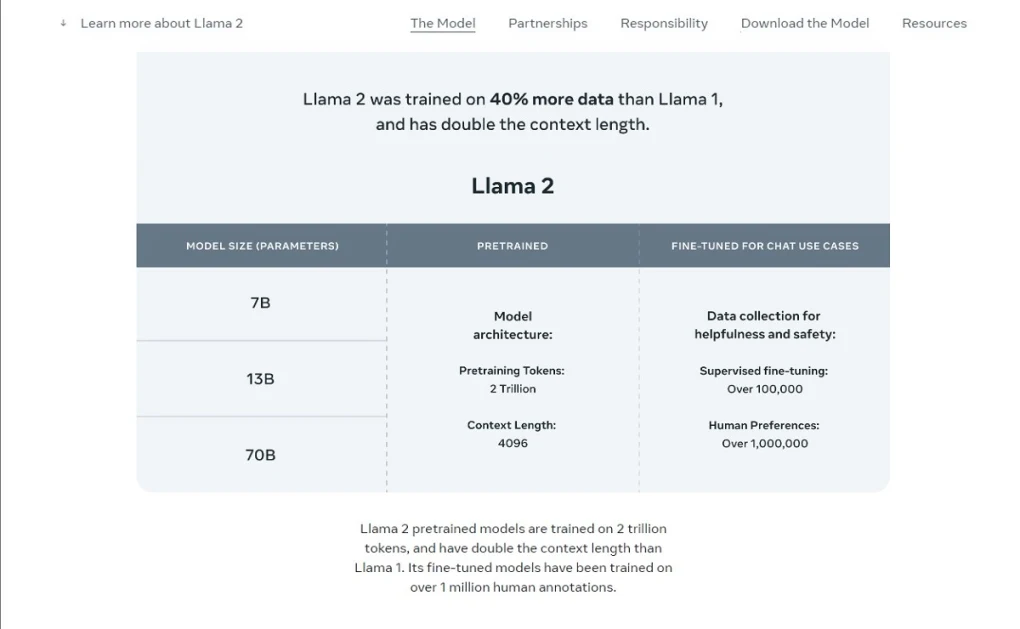
- Multiple model sizes available
- Good integration with machine learning workflows
Cons
- Larger models require powerful hardware
- Setup process can be complex for beginners
- AI-generated responses may require verification
- GPU acceleration is strongly recommended for best performance
Our Analysis
Llama 2 is one of the most influential open AI language model families for developers and researchers who want flexibility and control over AI workflows.
Its strongest advantages are:
- Open and flexible deployment options
- Strong developer ecosystem support
- Useful AI experimentation capabilities
- Multiple scalable model variants
The platform is especially valuable for AI developers, machine learning engineers, and researchers who want customizable AI systems without relying completely on proprietary cloud-based AI platforms.
While advanced AI deployment still requires technical knowledge and capable hardware, Llama 2 provides a strong foundation for building modern AI-powered applications and experimentation environments.
Overall, it is a powerful open large language model family for chatbot development, AI research, coding assistance, natural language processing, and machine learning workflows.
⚙️ Installation Guide (General Overview)
Step 1: Download Model Files
Download Llama 2 model files and required dependencies from official or trusted AI repositories.
Step 2: Prepare Development Environment
Install:
- Python
- AI libraries
- GPU drivers (if applicable)
- Required machine learning frameworks
Step 3: Install AI Frameworks
Set up frameworks such as:
- PyTorch
- Hugging Face Transformers
- CUDA Toolkit (for GPU acceleration)
Step 4: Configure Hardware Resources
Prepare:
- CPU inference settings
- GPU acceleration
- Memory allocation
- Storage optimization
Step 5: Load Llama 2 Model
Import and initialize the selected Llama 2 model inside the AI environment.
Step 6: Configure Inference Parameters
Adjust:
- Prompt behavior
- Token limits
- Temperature settings
- Performance optimization options
Step 7: Test AI Functionality
Run sample prompts and verify model responses.
Step 8: Integrate Into Applications
Use the model in:
- Chatbots
- AI assistants
- Productivity tools
- Automation systems
- Research applications
Step 9: Optimize Performance
Tune hardware and inference settings for better speed and efficiency.
Step 10: Maintain and Update Environment
Keep frameworks, dependencies, and drivers updated for stability and compatibility.
About SoftwareDownloading Editorial Team
The SoftwareDownloading Editorial Team researches Windows software, compatibility information, features, alternatives, and software-related guides for SoftwareDownloading.in.
Our pages are prepared using available product information and relevant documentation. When an application has not been personally tested, we distinguish research-based analysis from hands-on testing. Learn more about our review process
Apps Specs
Developer
Licence
Free
Version
varies-with-devices
Platform
Windows
Download Clicks
3
Page Reviewed
September 26, 2026
Releted Searches
Top Downloads


Related Topics
Disclaimer
This content is provided for educational and informational purposes only. We do not host, store, or distribute any software files on our servers. All trademarks, product names, and logos belong to their respective owners.
We strongly recommend downloading software only from official websites or trusted sources. We are not responsible for any damage, data loss, or issues that may occur from the use of third-party software.
Users should ensure they comply with all applicable laws and software licensing agreements in their country before downloading or using any software mentioned on this website.